Interview Preparation
No intro video yet
Start Date: TBA
Duration: N/A weeks
Total Seats: N/A
Seats Left: N/A
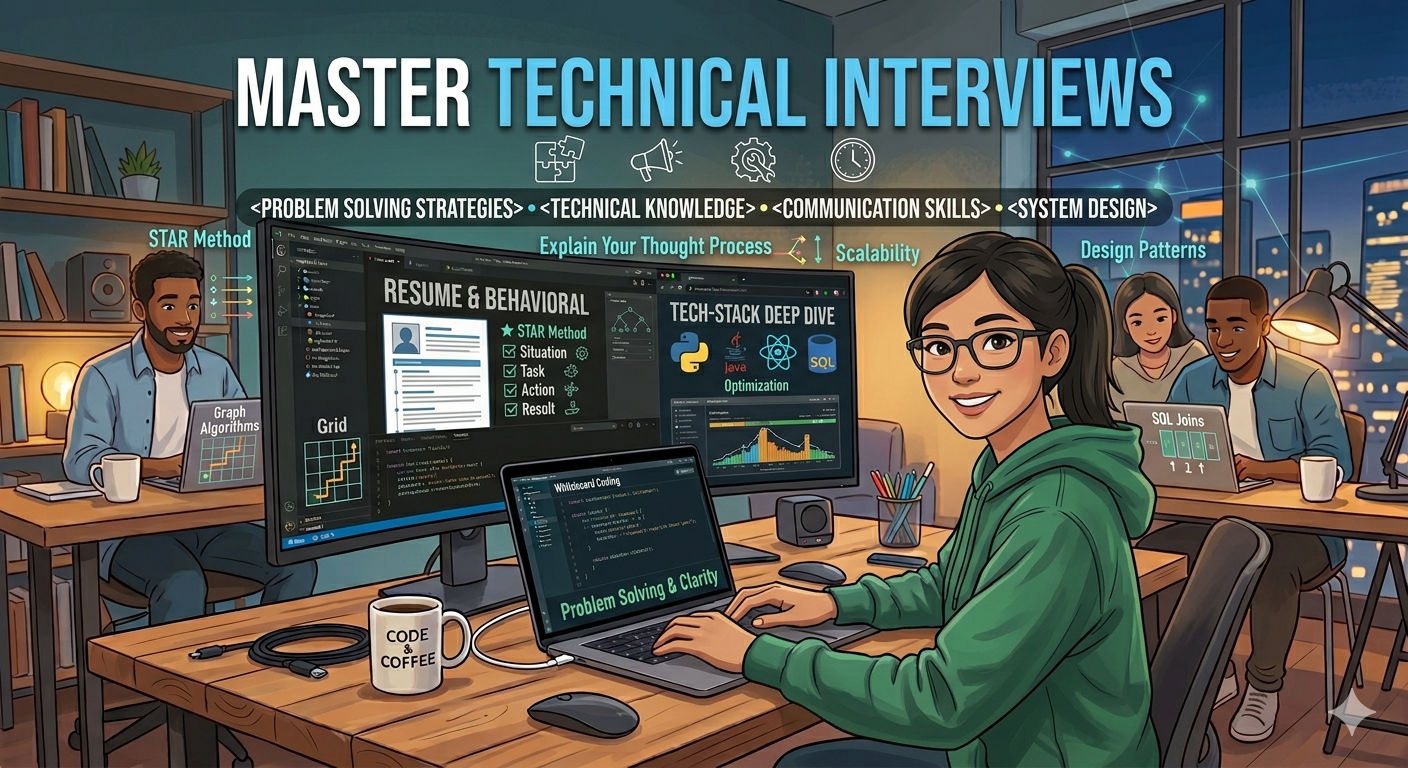
Land your dream tech job with a structured, end-to-end interview preparation programme covering coding challenges, system design, and behavioural interviews. Technical interviews are learnable skills — and this course gives you a proven system. Over 12 weeks you will sharpen your coding pattern recognition, develop a clear problem-solving framework, understand system design fundamentals, and walk into every interview with the confidence that comes from genuine preparation. What this course covers: → The most common coding interview patterns (not just random LeetCode grinding) → A repeatable framework for thinking through problems out loud → System design basics: how to design scalable, real-world systems → Behavioural interview mastery using the STAR method → Live mock interviews with actionable feedback → Resume, LinkedIn, and offer negotiation guidance Whether you are a student preparing for your first role or an engineer targeting a senior position at a top company, this course gives you the tools and practice needed to perform consistently under pressure.
Who this course is for
- Final-year students and recent graduates preparing for their first software engineering job
- Working professionals who want to switch to a top product-based company or FAANG
- Self-taught developers who feel confident coding but freeze up in structured interviews
- Anyone who has failed technical rounds and wants a systematic approach to improve
- Engineers targeting senior or staff roles that require stronger algorithmic and system design skills
- Candidates who want mock interview practice and personalised feedback before the real thing
What you’ll learn
- Approach coding problems using a clear, repeatable framework that interviewers respond to positively
- Recognise and apply the most common interview patterns: two pointers, sliding window, BFS/DFS, dynamic programming, and more
- Optimise solutions from brute force to efficient implementations within time and space constraints
- Explain your reasoning clearly and concisely while coding under pressure
- Solve medium-difficulty LeetCode problems consistently within 20–30 minutes
- Design scalable systems at a high level, covering key components such as load balancers, databases, caches, and message queues
- Structure compelling answers to behavioural questions using the STAR method
- Build a strong technical resume and LinkedIn profile that gets past initial screening
- Negotiate job offers with confidence using data-driven tactics
- Leave with a sustainable daily practice routine that maintains and improves your skills after the course
Course Structure
- How technical interviews are structured (phone screen, OA, onsite loops)
- The four-step problem-solving framework: understand, plan, code, test
- How to communicate your thought process to interviewers effectively
- Common interview mistakes and how to avoid them
- Setting up your practice environment (LeetCode, NeetCode roadmap, Excalidraw)
- Warm-up: easy array and string problems with the framework applied
- Two pointers and fast/slow pointer techniques
- Sliding window (fixed and variable size)
- Prefix sums and running totals
- Hash maps and frequency counting
- Sorting-based interview problems
- Binary search patterns on arrays and answer spaces
- Practice: 25 curated easy-to-medium problems
- Recursion and backtracking (permutations, combinations, N-Queens)
- Stack and queue-based problems (balanced brackets, next greater element)
- Monotonic stack and deque tricks
- Binary tree traversals and common tree problems
- Binary search tree problems
- Practice: 25 curated medium problems
- Graph traversal: DFS, BFS, topological sort, cycle detection
- Union-Find for connectivity problems
- Heap and priority queue patterns (top-K, median stream)
- Dynamic programming: memoization vs tabulation, classic 1D and 2D problems
- Greedy strategies and interval problems
- Practice: 25 curated medium-to-hard problems
- What interviewers look for in system design rounds
- Core building blocks: load balancers, relational and NoSQL databases, caches, CDNs, message queues
- CAP theorem and consistency vs availability trade-offs
- Designing for scalability and reliability
- Worked examples: URL shortener, rate limiter, news feed, notification service
- Framework for structuring any system design answer
- The STAR method with worked examples for the top 20 behavioural questions
- Crafting stories around leadership, conflict, failure, and impact
- Resume writing: structure, quantifying achievements, tailoring to job descriptions
- LinkedIn profile optimisation: headline, about section, featured projects
- Preparing a compelling project walk-through for your portfolio
- Researching companies and customising your narrative
- Timed mock coding sessions: medium problems under 30-minute constraints
- Live mock interview practice with structured feedback
- System design mock rounds (peer or instructor-led)
- Post-interview follow-up: thank-you notes and staying top of mind
- Evaluating and negotiating offers: market data, competing offers, counteroffer tactics
- Building a sustainable daily practice routine post-course
Instructor
Vansh Thakur
Vansh Thakur is a software engineer and educator passionate about making technology approachable for everyone. With hands-on experience across Python, C++, web development, and AI applications, he brings real-world context to every lesson. His teaching style focuses on clear structure, practical projects, and building genuine confidence.
FAQs
Do I need strong DSA skills before joining?
A basic understanding of common data structures (arrays, maps, trees) is helpful. If you want to build that foundation first, our Data Structures & Algorithms course is a great prerequisite.
Which programming language should I use?
You can use any language you are comfortable with. Python is the most commonly used in sessions, but Java, C++, and JavaScript are all supported.
How is this different from just practising on LeetCode?
This course gives you structure, patterns, and a problem-solving framework. Instead of grinding randomly, you learn to recognise problem types and apply proven approaches consistently.
Will the mock interviews be with real people?
Yes. Mock interview sessions involve peer practice and instructor-led rounds with feedback on your communication, approach, and solution quality.
How many coding problems will I solve?
Approximately 75 curated problems across Weeks 1–8, selected to cover the highest-frequency interview patterns.
Is system design covered in depth?
Week 9 covers the fundamentals needed for most interviews at mid-level and above. For very senior roles, additional self-study is recommended.
Will I receive a certificate?
Yes, a certificate of completion is awarded upon finishing the full 12-week programme.
Student Reviews
No reviews yet. Be the first to review!
No approved reviews yet.
Ready to start your journey?
Login to Enroll